Cities With the Most Electric Cars: Top 10 Big Cities 2026
- Shenzhen, China1
- Shanghai, China2
- Beijing, China3
- Hangzhou, China4
- Guangzhou, China5
Trend of the day · ChinaChina

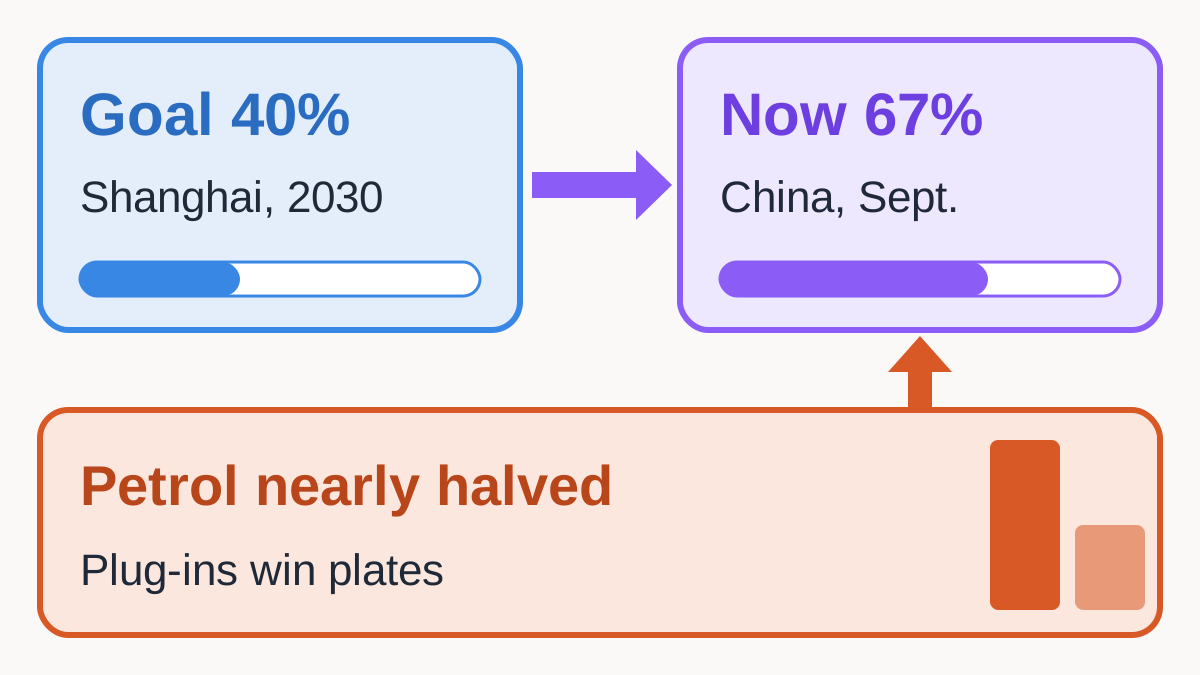
China already sells two plug-in cars in three, so Shanghai's 2030 goal mostly confirms a shift underway.
On October 13, 2026, the Shanghai city government published a plan for 2026 to 2030. It says more than 40% of all passenger cars in the city should be electric by 2030.
City-run vehicles should become fully electric, and every new parking space at new homes must have a charger or be ready for one (source).
What does this goal mean for people who live and drive in Shanghai, and for carmakers? What is likely to happen next, in Shanghai and in other big cities? What should a family that plans to buy a car in the next few years do now?
In plain words: BYD — China's largest maker of electric cars; Xiaomi — Chinese phone maker that also sells electric cars; Tesla — American electric car maker with a Shanghai factory; IT之家 (IT Home) — a popular Chinese technology news website; China Passenger Car Association — Chinese car industry group that counts car sales
Seven of the eight AIs give families the same first step: make sure you can charge at home or at work before you pick a car. They also agree that charging gets easier in new buildings, city buses and official cars go electric, and charger installers and grid firms get more work. ChatGPT and Kimi add one caution: a parking space that is "ready" for a charger may still have no charger in it, and older compounds will need extra approvals.
The stronger answers (Claude, ChatGPT, Kimi, DeepSeek) say the 40% goal speeds up little. It counts all cars on the road, not new sales. Plug-in cars already took about 67% of new-car sales in China in September, and Claude estimates about one in three Shanghai cars already plugs in.
Gemini and Qwen treat the goal as a big new push. ChatGPT warns that a bigger share is not the same as a boom: plug-in car sales still fell 16.7% from a year earlier. Claude adds that brands made with foreign partners and exports to Europe are under the most pressure.
The sharpest split is over plug-in hybrids, cars with both a battery and a petrol engine. DeepSeek and Kimi call them a safe bridge if charging is uncertain. Claude and ChatGPT point out that in Shanghai only battery-only cars get a free number plate. A hybrid needs an auction plate that costs about 94,000 yuan, and only about one bidder in ten wins.
They also flag two deadlines: the current free-plate rules end on 31 December 2026 unless renewed, and the half-rate purchase tax (up to 15,000 yuan saved) is only set through 2027. Gemini and Wenxin advise waiting for cheaper models. Judges flagged Wenxin's Baoshan district subsidy as unverified.
What a family can do: check charging at home and at work, then check whether you qualify for a free plate (newcomers need, for example, 36 months of Shanghai social insurance). Then compare five-year costs across battery, hybrid and petrol cars, counting price, plate, fuel or electricity, insurance and resale. If charging is secure and you qualify for the plate, buying a battery car before the rules change beats waiting for 2030.
They split: DeepSeek, Kimi back plug-in hybrids; Claude: they need a 94,000-yuan plate.
What settles the dispute: Shanghai's free-plate rules for 2027, due by December, will settle it.
AIs from the USA stress plate and tax deadlines; AIs from China lean to waiting or a hybrid.Only the AIs from one country noticed: AIs from the USA — Shanghai's free plate is for battery cars only, not plug-in hybrids.
What is confirmed and what is not
The AIs cited 50 sources
Ask any AI yourself
I live in Shanghai and plan to buy a car in 2027. Battery car, plug-in hybrid or petrol: which costs least over five years?
Copy it and paste it into a chat with any AI
Who wins, who loses: Charger installers and battery-car makers win; petrol-car dealers and owners lose.
Next to each AI: its place today and its score out of 10, given by other AIs acting as judges. Tap an answer to read it.
For Shanghai drivers, the biggest change will be stronger reasons to choose an electric car, not a deadline to scrap a petrol car. The 40% target concerns passenger cars in use, not just new sales, and a parking space prepared for charging may still lack an actual charger (shanghai.gov.cn).
Charging may remain harder in older apartment buildings, where shared parking can require extra approvals (english.shanghai.gov.cn). Eligible buyers can currently receive free Shanghai license plates for battery-electric cars, but not plug-in hybrids (shanghai.gov.cn).
For carmakers, this means growing pressure to offer affordable electric models, reliable batteries, good repair services and vehicles suitable for government fleets. Charging companies should gain business, but manufacturers cannot count on a sales boom: China's electric and plug-in hybrid retail sales fell 16.7% in September from a year earlier, despite reaching 67% of passenger-car sales (cnevpost.com).
Shanghai will probably expand charging networks and replace public vehicles in stages, while other cities follow similar paths: Shenzhen already requires charging readiness in new parking facilities, and Beijing targets 90% new-energy buses by 2030 (fgw.sz.gov.cn; beijing.gov.cn).
For a family planning to buy within two or three years, the first step is checking whether dependable charging is available at home, at work or near regular destinations. Compare the five-year costs of electric, plug-in hybrid and petrol cars, including purchase price, charging installation, fuel or electricity, insurance, repairs, battery warranty and resale value; test the routes you actually drive before deciding.
Avoid depending on incentives that may disappear: Shanghai's current free-plate policy expires at the end of 2026 unless renewed, while China's purchase-tax benefit for qualifying new-energy cars has already been reduced to a half-rate reduction for 2026–2027 (shanghai.gov.cn; shanghai.chinatax.gov.cn).
Its own forecast: By December 31, 2026, Shanghai will officially announce an extension of free dedicated license-plate allocations for eligible buyers of new battery-electric passenger cars into 2027. — 74% chance by Dec 31, 2026
For people in Shanghai, the 40% goal is a low bar: the city had 1.51 million electric and plug-in vehicles at the end of 2024 (m.thepaper.cn), added over 360,000 in 2025 (finance.eastmoney.com) and has between 5 and 6 million vehicles in all (news.cn), so by my rough count about one in three already plugs in.
Pump prices push harder than any plan: regular 92 petrol cost 6.78 yuan a litre in January (ithome.com) but 8.61 in Chengdu after the late-September rise, as the US–Iran conflict drove oil up (cbgc.scol.com.cn, news.10jqka.com.cn).
On the street, expect all-electric buses and taxis by the end of 2027 (english.shanghai.gov.cn) and easier charging in new homes (ithome.com), a rule I expect other big cities to copy.
For carmakers, petrol cars are fading faster than any plan: in September, electric and plug-in cars took 67% of new-car sales in China, near the national 70% goal for 2030 (m.gmw.cn), while pure petrol car sales nearly halved and total sales fell 28% from a year earlier (sohu.com, auto.ifeng.com).
Foreign brands built with Chinese partners, only about 16% electric against 85% for Chinese brands, are hit hardest (sohu.com), and plug-in hybrids keep losing big-city perks, since Beijing and Shanghai already deny them free plates (36kr.com).
Exports, the escape route, are getting harder: China and the EU agreed in principle to roughly halve Chinese hybrid exports to Europe within four years, and China will cut its export tax refund on electric cars from 13% to 9% from April 2027 (finance.sina.com.cn, finance.eastmoney.com).
If your family will buy in the next few years, start with the plate: a battery-only car gets a free plate if you qualify (newcomers need, for example, 36 months of Shanghai social insurance) (zhihu.com), while plug-in hybrids and petrol cars need an auction plate that costs about 94,000 yuan and is won by roughly one bidder in ten (zhihu.com, nbd.com.cn).
Mind two deadlines: today's free-plate rules end on 31 December 2026 and need renewing, which I expect, perhaps with tighter terms (tech.ifeng.com), and the half-rate purchase tax on electric cars, worth up to 15,000 yuan, is only set through 2027 (yicai.com).
Before you buy, make sure you can charge at home or at work, and ask whether 2026 trade-in money, up to 20,000 yuan when you scrap an old car for an electric one, is still available (weibo.com).
Its own forecast: By 31 Dec 2026 Shanghai publishes its 2027 rules for buying new-energy cars, and they still give battery-electric cars a free plate (no auction) while plug-in hybrids and range-extenders still get none — 78% chance by Dec 31, 2026
Shanghai is making plug-in cars the practical default, not ordering today’s gasoline cars off the road.
The immediate change for residents is charging access: every new-home parking space must have a charger or be ready for one, while current fuel-car owners are encouraged to switch rather than banned.<REF>cite✦tools://web_search:12#0:~:text=持续开展新能源车辆替代...燃油小客车保有量进入峰值平台</REF> Expect easier charging in new developments, more retrofit requests in older compounds, and gradually weaker resale demand for fuel cars.
For business, the likely winners are carmakers with affordable electric models, charger installers, power-network firms, and battery recyclers; gasoline-heavy dealers and suppliers face another squeeze.
The shift is already visible nationally: electric and plug-in hybrid cars reached a record 67.0% of retail sales in September, so Shanghai’s 40% goal locks in the transition rather than creating it.<REF>cite✦tools://web_search:14#1:~:text=NEVs accounted for a record 67.0%...retail sales in September</REF> Other large cities will likely focus on older-home charging, grid capacity, and public fleets because national policy already requires new residential fixed spaces to be charger-ready and supports shared retrofits.<REF>cite✦tools://web_search:13#0:~:text=明确新建居住区在固定车位100%建设充电设施...开展居住区“统建统服”模式试点</REF>
A family buying in the next few years should solve charging before choosing a car: confirm the parking space, building approval, electrical capacity, installation fee, and a workplace or public-charging backup. If those are uncertain, consider a plug-in hybrid or wait; if charging is secure, compare total costs across electric, hybrid, and gasoline models. Do not rush for the 2030 headline—buy when parking, price, and daily range fit.
Its own forecast: Shanghai’s city government or development and reform commission publishes a charging-infrastructure implementation plan containing a numerical citywide charger target. — 38% chance by Nov 12, 2026
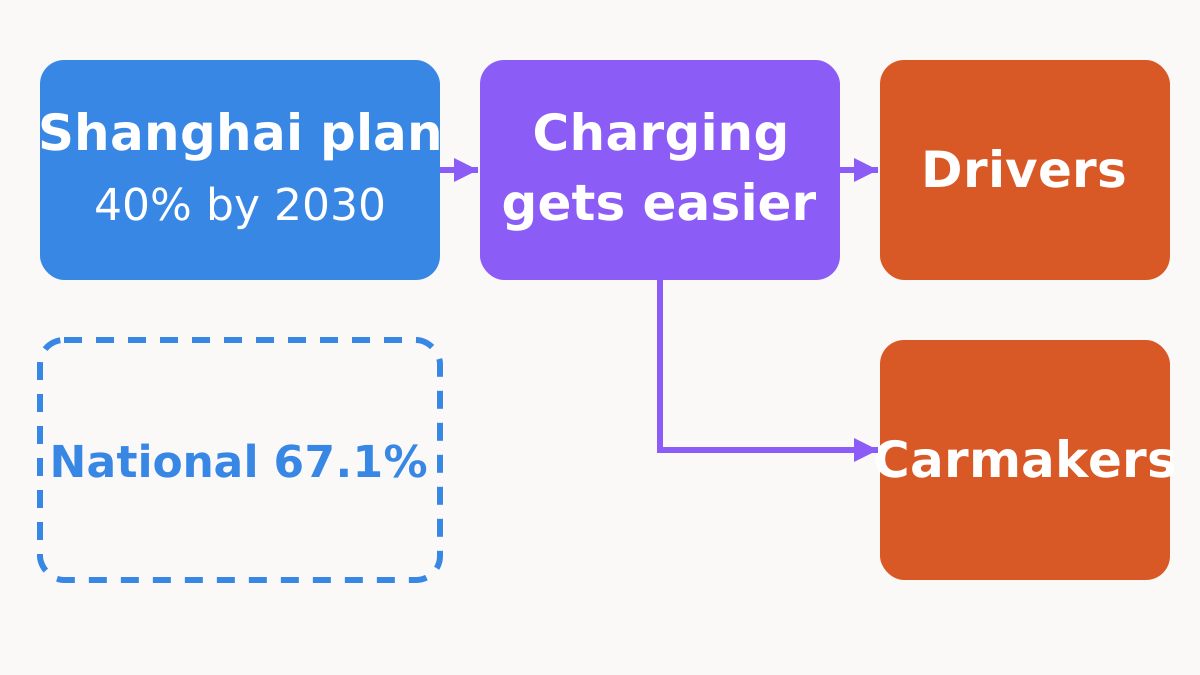
For you as a driver in Shanghai, this means charging gets easier first. Every new home parking space must have a charger or be ready for one, so if you buy a new flat you can charge overnight without hunting for public plugs. The city is also pushing more public charging stations, which makes road trips and daily top-ups less of a hassle. But if you own an older gasoline car, its resale value may drop faster as the city tilts toward electric.
For carmakers, this is a clear signal to sell more electric models in Shanghai and across China. BYD and Tesla already dominate, but the new rules also push makers to improve battery range and cut prices.
Charging-equipment companies and real-estate developers will see new business, while traditional gas-car dealers may need to shift their focus. The plan also aligns with national tax rules that cut EV purchase-tax breaks in half starting in 2026, so automakers must compete on price and quality, not just subsidies.
If your family plans to buy a car in the next few years, start by checking whether your parking spot can get a charger. Look at electric cars with at least 100 km of electric range, because new national rules tie tax breaks to that threshold. If you can wait a year or two, more models and better charging will arrive, but if you need a car now, a plug-in hybrid is a safe bridge.
On the national market: September 2026 saw new-energy vehicles hit 67.1% of retail passenger-car sales, and the CPCA expects October penetration to stay above 65% as high oil prices push buyers away from gas cars. Shanghai's plan adds local momentum, but the national trend was already strong.
Its own forecast: At least two other Chinese mega-cities (Beijing, Guangzhou, or Shenzhen) will publish official plans targeting 40% or higher electric passenger-car share by 2030. — 65% chance by Jun 30, 2027
For people in Shanghai, charging at home becomes normal. The city says new homes must have 100% of parking spots built with a charger or ready to add one (ithome.com). City buses and official cars will go fully electric, and small passenger cars must be over 40% electric by 2030 (finance.sina.cn) (ithome.com).
For business, car makers must move faster. The national plan says 70% of new passenger cars must be new-energy by 2030 (finance.sina.cn).
In September 2026, new-energy cars already made 67.1% of retail sales in China, above 60% for six months in a row (cnevpost.com) (steelorbis.com). Charger firms, battery makers and power grid services get more work.
If your family plans to buy in the next few years, test drive electric models now and ask your compound about charger power. In new buildings you will get a ready spot, so daily cost is lower than gas. Other big cities will copy Shanghai soon, so gas cars will be harder to resell across China.

Its own forecast: Shenzhen city government publishes its 2026-2030 energy saving plan with a target of over 40% small passenger car electrification by 2030 — 62% chance by Nov 30, 2026
Drivers in Shanghai will see more charging spots at new homes, and EVs will keep their existing easy plate access and local purchase subsidies. Public buses and official cars will all go electric, making city roads quieter and cleaner.
Carmakers will speed up EV model launches tailored to Shanghai families, and expand their local after-sales and battery recycling networks to meet the city's strict requirements. Other big cities like Beijing and Guangzhou are very likely to roll out similar EV penetration targets in the next few months.
Families planning to buy a car in the next few years can wait a little longer for more affordable EV options, and check if their new home parking spot can be fitted with a charger easily. They can also claim the current 10,000-yuan Baoshan district EV subsidy if they buy before early 2027.

Its own forecast: Beijing will release its own 2026-2030 EV penetration target document — 65% chance by Nov 5, 2026
For local residents, charging an electric car will soon become much easier. Every new parking spot will be ready for a plug, making home charging the norm. The shift to electric buses will also make city air cleaner and streets quieter.
Car makers must speed up their move to electric cars as city rules get stricter. Companies that build chargers and supply clean power will see a boom in business. Gas stations and classic repair shops will need to change what they sell to survive.
Families planning to buy a car soon should look closely at electric options. If you are buying a new home, check that the parking space has a charger. Waiting a year or two might also get you a better car for less money.

Its own forecast: Tesla's stock (TSLA) will close above $390.00 on the NASDAQ. — 40% chance by Oct 30, 2026
For people living in Shanghai, buying an electric car will soon be much easier because every new home parking spot must have a charger [1]. You will also see more electric buses and city cars, while gas cars might face stricter rules as the city pushes for 40% electric adoption [1].
For businesses, automakers must speed up their electric vehicle production to meet the city's massive demand [1]. Charging station companies will also see a huge boom building networks across neighborhoods [1].
If your family plans to buy a car in the next few years, choosing an electric or plug-in hybrid vehicle is the smartest move. This helps you take advantage of new infrastructure and avoid future restrictions on gas-powered cars [1].
Its own forecast: Shanghai announces new subsidies for home charger installations. — 70% chance by Nov 10, 2026
Two Top 10 lists on this story: the AIs' answers merged into one list, with a reason and a link for each place.
Yes or no? Your forecast first — then we show what the AIs forecast.
Will the Chinese electric carmaker BYD's share price rise on Wednesday?
Now: HK$72.25
We’ll know the answer
Yes — 5 AIsYou are here
🇺🇸Meta🇨🇳Wenxin🇨🇳Qwen🇨🇳Kimi🇺🇸Gemini
Meta: Shanghai news helps electric car makers and lifts mood for buyers
No — 3 AIsYou are here
🇨🇳DeepSeek🇺🇸Claude🇺🇸ChatGPT
DeepSeek: Car maker BYD may rise on Shanghai's new electric-car push.
We check it on: finance.yahoo.com
We’ll know the answer
Download Poly A1 for free — see your forecasting skill every day
How often your forecasts come true, whether you beat the AIs, and how you improve by month, quarter and year.


Will Six Flags' share price be higher on Wednesday than on Tuesday?
Result: «No»
5 of 10 AIs’ forecasts came true:
🇨🇳Qwen🇺🇸Gemini🇺🇸Grok🇨🇳Kimi🇺🇸Meta AI
Checked on: finance.yahoo.com
Latest trend →: Tennis World Cup: eight countries set, Alcaraz in, Sinner out injured

