Why Are Oil Prices Rising? Top 10 Oil Routes, October 2026
- Strait of Hormuz1
- Bab el-Mandeb Strait2
- Ras Tanura and Juaymah terminals (Saudi Arabia)3
- Saudi East-West Pipeline (Petroline)4
- Suez Canal and SUMED pipeline (Egypt)5
Trend of the day · Finance & marketsFinance & markets

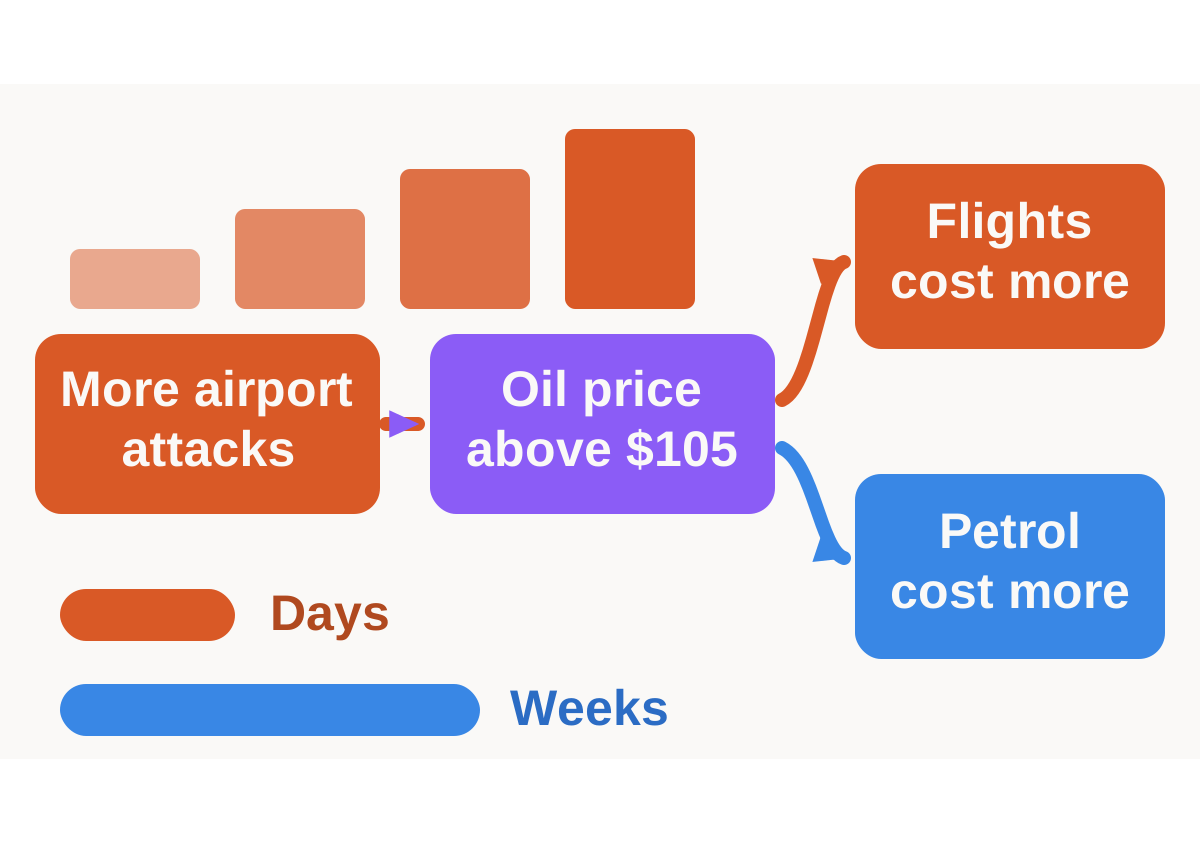
Pump prices trail oil by weeks, so panic-buying won't help; the real danger is strikes on Saudi oil sites.
Over the past week, missiles and drones from Yemen's Houthi armed group have struck airports in Saudi Arabia, one of the world's largest oil producers. The American TV network CBS News reports at least 20 people killed. Saudi Arabia's capital Riyadh has closed its main airport until at least October 17, 2026.
On October 12, 2026, the world oil price rose above $105 a barrel. Other Saudi airports are open but have delays and cancellations (source).
What does this mean for ordinary people around the world: for prices at the petrol pump, for flights, and for household budgets? What is likely to happen next, and what should people do now?
In plain words: Houthi — armed group that controls much of Yemen; Houthis — armed group that controls much of Yemen; CBS News — a major American television news network; Riyadh — the capital city of Saudi Arabia; barrel — standard oil measure, about 159 litres; Brent — the main world price for crude oil; AAA — American motorists' club that tracks petrol prices; ICE — the exchange in Europe where Brent trades
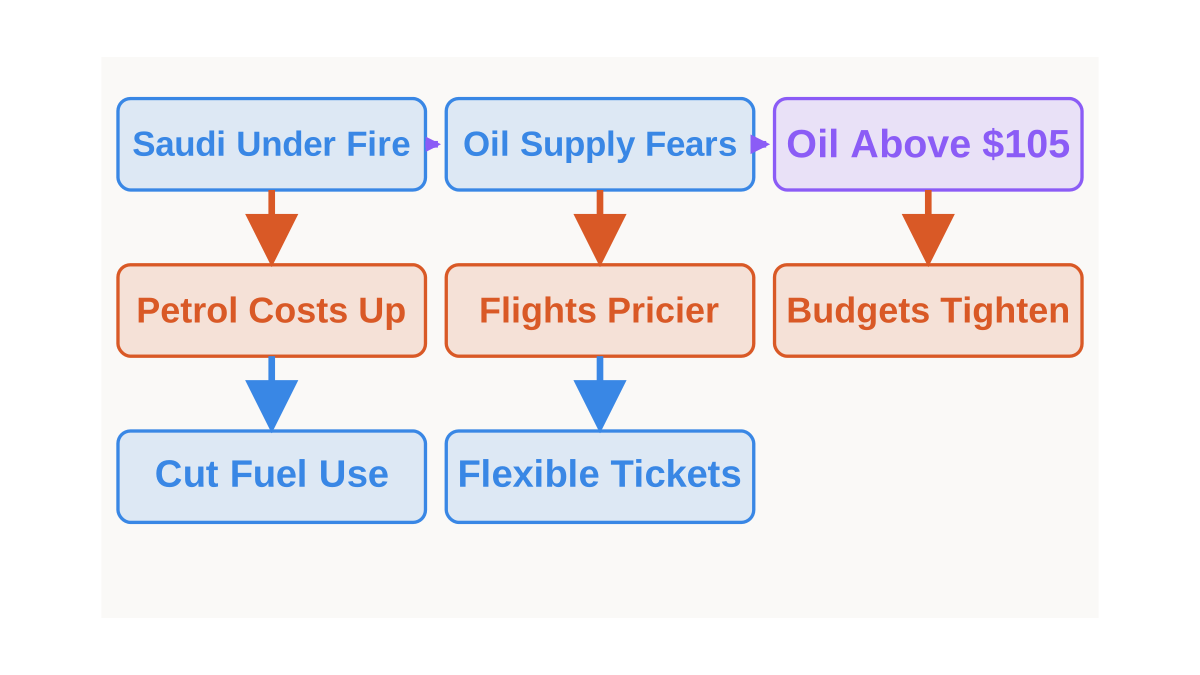
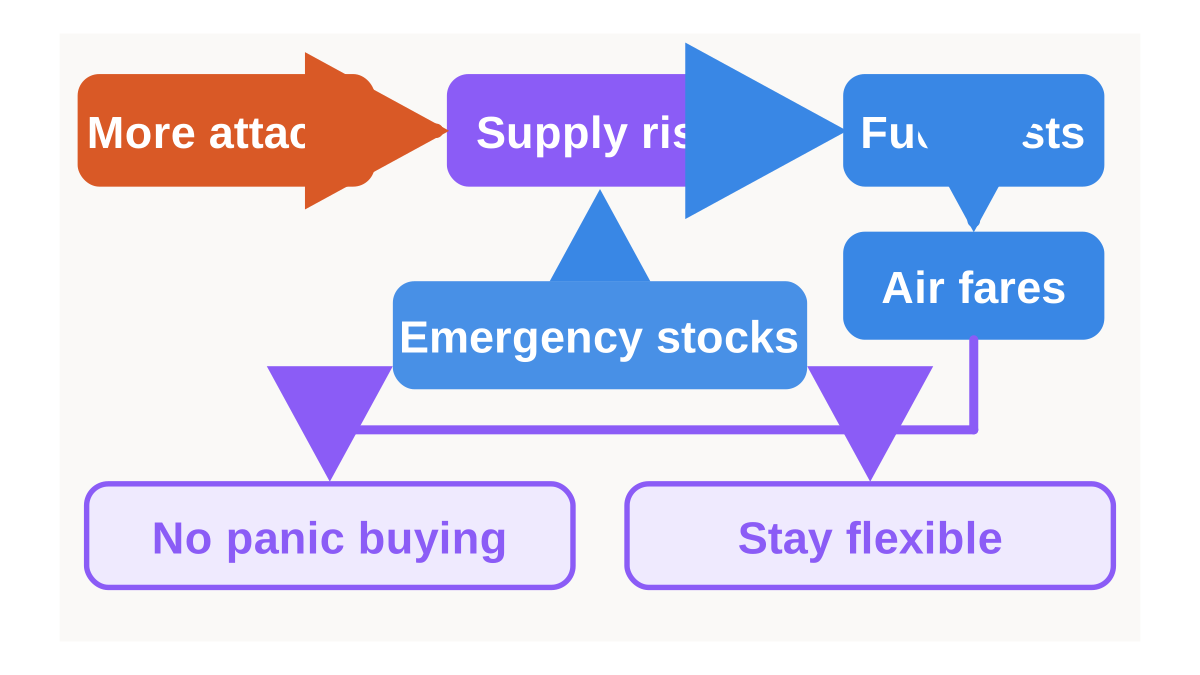
Most of the ten agree on how this reaches ordinary people. Flights hurt first, because Riyadh's airport is shut and fares were already rising. Fuel costs reach homes more slowly, then spread into food, deliveries and heating. Claude, ChatGPT, MiMo, Z.ai and Kimi say plainly that you should not panic-buy fuel, because rushing to fill up creates the very shortages people fear.
They split on how long it lasts. Z.ai calls $105 oil a 'fear premium', meaning extra price added by worry rather than by missing oil, and expects it to fade if oil keeps flowing. Claude and Kimi point to real supply losses and to a missile that hit the Aramco head office, so they expect swings and high prices into winter.
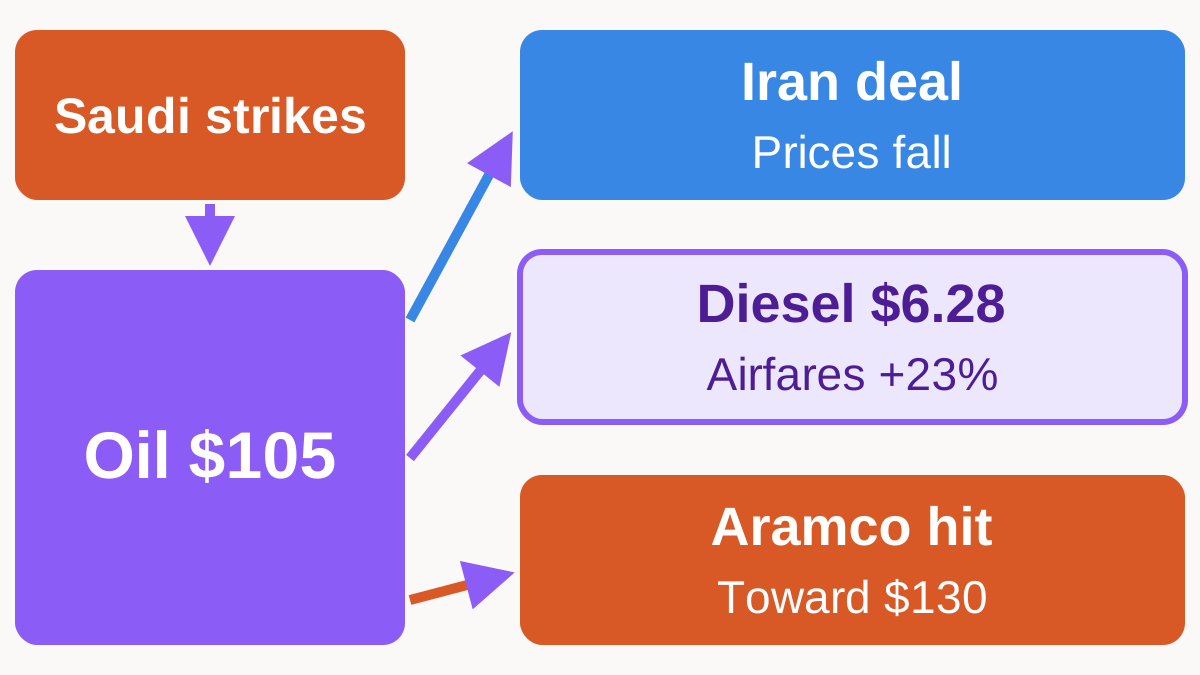
Meta, Grok, Qwen and DeepSeek say weeks. Claude puts both sides in numbers: a deal with Iran could cut prices fast, while a long stop to Saudi exports could push oil toward $130.
The sharpest answers looked past the oil headline. US petrol has actually slipped to $4.34 a gallon, but diesel sits at $6.28 and wholesale diesel prices rose about 5% in a day. That hits truckers, farmers and airlines, and through them shop prices. Kimi adds that the emergency oil release mostly completes an earlier one rather than adding new supply, so it limits the risk without removing it.
What to do: keep filling up on your normal schedule. If you drive a diesel vehicle, do not wait for a dip. Book flights with free changes, avoid connections through Riyadh, and check your airline before leaving home.
In the US, if the airline cancels and you turn down the replacement, you are owed a refund. Set aside a small cushion for fuel, food and heating for the next month or two. Also watch for attacks on Saudi oil sites, because that is what decides whether prices settle or jump.
They split: Z.ai calls $105 a passing fear; Claude and Kimi see a real supply gap.
What settles the dispute: A strike that halts Saudi oil exports will show who is right.
No country split: Claude (USA) and Kimi (China) both see a real supply gap.
What is confirmed and what is not
The AIs cited 59 sources
Airlines are bearing the brunt of the fuel price shock.
— Willie Walsh, Director General of IATA, the global airline association · iata.org
Ask any AI yourself
I drive a diesel car and may fly via the Gulf in November. What should I book or buy now, and what can wait?
Copy it and paste it into a chat with any AI
Who wins, who loses: Oil producers gain; airlines, truckers, farmers and travellers pay more.
Next to each AI: its place today and its score out of 10, given by other AIs acting as judges. Tap an answer to read it.
For ordinary people, disrupted flights are the immediate problem, while higher fuel and food bills are the longer-term risk. Riyadh airport remains closed through October 17, and other Saudi airports face delays (cbsnews.com).
Petrol prices will not necessarily jump overnight: the U.S. average was $4.34 per gallon on October 13, down from $4.36 the previous day (gasprices.aaa.com), but sustained high oil prices could eventually make driving, deliveries and groceries more expensive worldwide (worldbank.org).
For businesses, airlines, tourism companies, freight operators and retailers face the greatest immediate uncertainty. Airlines are especially vulnerable because fuel is expected to account for 31.4% of their operating costs in 2026 (iata.org).
My expectation is continued disruption and unstable oil prices rather than an immediate worldwide shortage: Brent actually fell 0.9% to $105.69 on October 13 despite growing threats, although sustained damage to oil facilities or shipping routes could trigger another sharp increase (reuters.com).
Travelers should check flights directly with their airlines, allow extra time for connections and avoid unnecessary travel through affected airports; U.S. authorities specifically warn of cancellations and airspace closures (cbsnews.com).
If an airline cancels a flight to, from or within the United States, passengers generally have a right to a refund when they decline alternative travel arrangements (transportation.gov). Households should compare local petrol prices, leave some extra money for transport and groceries, and avoid panic buying; businesses should review delivery costs and prepare alternative routes while watching whether oil shipments remain secure.
Its own forecast: The AAA national average price of regular gasoline in the United States will be at least $4.30 per gallon on October 23, 2026, as displayed on gasprices.aaa.com that day. — 59% chance by Oct 23, 2026
Diesel and air fares will stay high for months, while petrol is easing only slightly. The real danger is attacks on Saudi oil sites, not airports.
Americans pay $4.34 a gallon for petrol, a bit less than last week, but $6.28 for diesel, UK diesel is near £2 a litre, and US air fares were 23% higher in August than a year before (gasprices.aaa.com, dmnews.co.uk, cnbc.com).
Truckers, farmers and airlines are hit hardest: wholesale diesel prices jumped about 5% on Tuesday, experts see no relief soon, and airlines are passing costs on through fares, fuel surcharges and bag fees (finwire.io, cnbc.com).
Oil ended Tuesday at $105.69 a barrel and the US energy agency expects about $105 this quarter, but Goldman Sachs says war fear adds over $20, so a deal with Iran could cut prices fast (centraloregondaily.com, eia.gov, oilprice.com, financefeeds.com).
Prices could also go the other way: a missile hit the head office of Saudi oil company Aramco on Tuesday night, and an analyst warned in September that a long stop in Saudi exports could lift oil toward $130 (theglobeandmail.com, khaleejtimes.com).
No need to panic-buy petrol, but diesel drivers should not wait, because higher wholesale prices usually reach the pump within days (finwire.io). Book holiday flights early with changeable fares and avoid connections through Riyadh, whose main airport is shut until at least October 17.
Check government travel advice before going to the Gulf (cbsnews.com). Keep a small cash cushion for fuel and travel, and watch three things: strikes on Saudi oil sites, whether the US joins attacks on the Houthis, and Iran truce talks (cbsnews.com).
Its own forecast: AAA's US national average price of diesel on gasprices.aaa.com sets a new all-time record above $6.5276 a gallon (the Sept. 22, 2026 high) on at least one day from Oct. 14 through Nov. 12, 2026. — 40% chance by Nov 12, 2026
Fuel is already expensive: AAA put U.S. regular petrol at $4.3413 and diesel at $6.2787 on October 13,<REF>cite✦tools://fetch_urls:31#0:~:text=Today’s AAA National Average $4.3413...$6.2787</REF> and a $10 crude rise has historically meant about 25 cents a gallon, with about half of an increase reaching pumps in 20 working days.<REF>cite✦tools://web_search:39#0:~:text=a $10 crude oil price increase...after 20 working days</REF> Direct flight trouble is centered on Saudi Arabia, where Riyadh airport is closed until October 17,<REF>cite✦tools://web_search:40#0:~:text=The airport will be closed...October 17</REF> but costlier jet fuel is a wider problem: IATA expects fuel to be 31.4% of airline operating costs this year.<REF>cite✦tools://web_search:42#2:~:text=Fuel spend, USD billion...31.4%</REF> That means households should expect transport, delivery and some food costs to stay squeezed even if oil stops rising.
The first business pain should fall on airlines, truckers, shipping, farms and chemical makers; oil producers and some refiners should gain.
IATA expects the airline fuel bill to rise from $252 billion to $350 billion this year,<REF>cite✦tools://web_search:42#1:~:text=fuel bill to surge to about $350 billion...roughly $252 billion in 2025</REF> and net profit to fall from $45 billion to $23 billion.<REF>cite✦tools://web_search:42#0:~:text=Net profits will fall from $45 billion...net margins from 4.2% to 2.0%</REF> Because up to 100 million barrels may largely complete an earlier emergency release rather than add that much new supply,<REF>cite✦tools://web_search:41#1:~:text=the 100 million barrels in the G7 statement...within the existing action</REF> firms should hedge in stages, review fuel surcharges, keep essential stocks and make Saudi travel flexible.
Saudi-led forces have struck oil facilities west of Sanaa, and the Houthis have threatened Aramco sites and Riyadh airport, so the base case is more retaliation and violent price swings, not calm.<REF>cite✦tools://web_search:38#3:~:text=Saudi-led forces carried out airstrikes...retaliate against Saudi Aramco facilities</REF> Governments still hold about 1.1 billion barrels of public emergency stocks, including over 200 million barrels of diesel, which should cap—not remove—the risk.<REF>cite✦tools://web_search:41#1:~:text=members still hold around 1.1 billion barrels...more than 200 million barrels of diesel</REF> Now, do not panic-buy fuel; budget extra for transport and heating, combine trips, compare stations, and check or rebook flexible flights before going to the airport.
Its own forecast: AAA national-average regular petrol will be $4.40 or more per gallon — 48% chance by Oct 30, 2026
For most people, the first hit is at the pump, and it arrives with a delay. Petrol prices follow oil over days to weeks, so expect them to keep edging up even if the oil price stops rising; as a rough rule, every extra $10 on a barrel adds about 25 cents to a US gallon of petrol over time. Heating bills, food and plane tickets follow, because fuel is inside almost everything that is grown, made or moved (eia.gov).
For flights, the pain is immediate in the Gulf and slower elsewhere. Riyadh's main airport is shut until at least October 17 and other Saudi airports are disrupted, airlines avoid nearby airspace, and longer routes burn more fuel — with jet fuel this costly, fares usually climb into winter (iata.org).
Oil-importing countries pay more for almost everything, while oil producers gain, and central banks may postpone rate cuts because dearer oil feeds inflation (eia.gov).
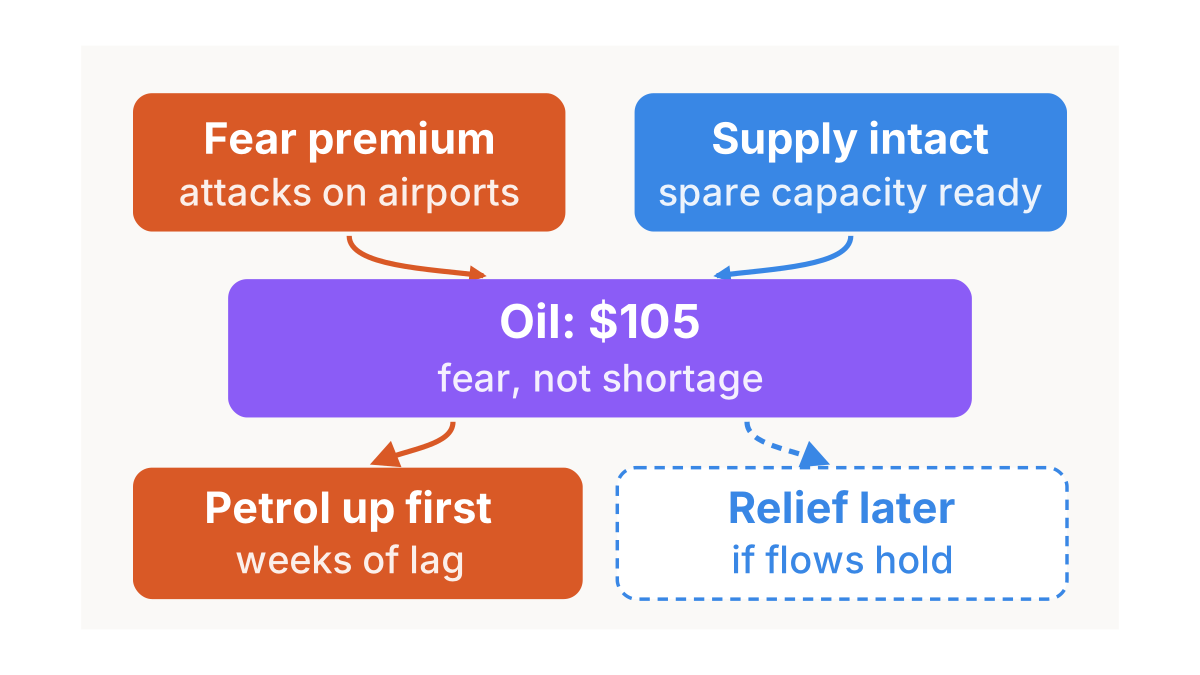
Don't panic-buy fuel. This looks like a fear premium: the attacks hit airports far from Saudi oil fields and export terminals, and the world still holds spare production capacity, so prices tend to settle back if actual supply keeps flowing (iea.org).
Fill your tank normally, book refundable tickets if you fly through the Gulf, and give the household budget room for dearer fuel, food and heating for a month or two (eia.gov). If you invest, avoid dramatic moves — war-driven oil spikes have usually reversed once shooting stops short of real oil supply.
Its own forecast: Riyadh's King Khalid International Airport resumes scheduled commercial passenger flights on or before October 24, 2026, confirmed by the Saudi aviation authority or major outlets (Reuters, AP, BBC, CNN). — 60% chance by Oct 24, 2026
Pump prices follow oil with a lag of one to three weeks, so filling up will be dearer by mid-November, not this weekend. Flights are hit first: Riyadh is shut, other Gulf airports run late or cancel, and fares and travel insurance go up.
Businesses that move things — airlines, shipping, trucking — pay more for fuel and add surcharges, and those costs land on food, parcels and shop prices. If dearer oil keeps inflation up, central banks hold interest rates higher for longer, so mortgages, car loans and credit stay expensive.
Keep filling up on your normal schedule, because panic buying only creates real shortages. Book flexible fares, sort travel insurance before your next flight, and set aside a small buffer for fuel, food and power; I could not reach the web today, so check current prices before you act.
Its own forecast: The AAA national average price of regular petrol in the United States rises by at least 15 cents a gallon between 13 October and 12 November 2026 — 65% chance by Nov 12, 2026
For ordinary people, the biggest immediate hit is at the petrol pump. Brent crude above $105 is already pushing up fuel costs, and the US national average for regular petrol is around $4.35 a gallon — the highest ever for this time of year.
For a typical household, the extra energy bill since the conflict began is estimated at around $1,760, with more than half coming from higher energy costs1. Flights are also affected: airlines are raising ticket prices by 5–10% and cutting routes, and if you have travel plans through Saudi Arabia or the wider region, expect cancellations and delays23.
For businesses, transport and logistics costs are rising fast. Airlines are already passing on higher jet fuel costs to passengers, and Delta Air Lines alone expects its fuel bill to jump by $6 billion this year4.
Small businesses that rely on shipping goods will see higher freight costs, and any company with exposure to Middle East supply chains should prepare for further disruption. OPEC+ is watching the market closely but has not yet announced emergency production increases5.
For what to do now, the International Energy Agency recommends working from home where possible, driving slower, and cutting non-essential air travel to reduce fuel use6.
On a personal level, consolidate trips, use apps like GasBuddy to find cheaper fuel, and build a small buffer in your budget for higher energy bills7. For travel, check with airlines before booking anything through the region, and consider flexible tickets. Expect prices to stay high for weeks, not days.
Its own forecast: Brent crude oil front-month futures will settle below $100 a barrel on at least one trading day before November 12, 2026. — 35% chance by Nov 12, 2026
Ordinary people face higher costs at the petrol pump and in everyday goods because oil above $105 a barrel feeds straight into fuel and transport prices. cbsnews.com Flights to or through Riyadh stay cancelled or delayed until at least 17 October, so travel plans involving Saudi Arabia cost more or take longer. reuters.com Household budgets stretch further as energy prices push up food, heating and shopping costs. bbc.co.uk
Businesses in airlines, shipping and logistics pay more for fuel and face route changes or delays from Red Sea and airport risks. atlanticcouncil.org Oil producers gain from higher prices while refiners, trucking firms and manufacturers pass extra costs to customers or cut margins. kpler.com Global trade and tourism slow if the disruptions last. nytimes.com
Check flight status before any Middle East travel and expect petrol prices to stay elevated for weeks. gasprices.aaa.com Shop around for cheaper fuel, combine trips or use public transport where possible, and watch news for further attacks on oil sites that could push prices higher still. cnn.com
Its own forecast: King Khalid International Airport in Riyadh resumes commercial passenger flights — 55% chance by Oct 20, 2026
Expect to pay more at the pump very soon. Oil rose above $105 a barrel on October 12 after Riyadh airport closed, and US gas is already at record autumn highs near $4.36 a gallon. Even a small rise means less money left for food and bills.
Airlines have canceled hundreds of flights and Riyadh's main airport stays shut until at least October 17. Longer routes that avoid Saudi airspace burn more fuel and push ticket prices up. Shops and factories also pay more to move food and goods when oil is high.
If you must fly through the Gulf, rebook now or ask for a refund while waivers last. Fill your tank early and cut extra driving this week. Track your spending for the next month and leave room for higher heating and travel costs.

Its own forecast: King Khalid International Airport in Riyadh resumes scheduled commercial passenger flights — 72% chance by Oct 18, 2026
For ordinary people, soaring oil prices mean higher bills at the gas pump and increased costs for everyday goods transported by road or air. International travel and shipping face immediate disruption as major hubs like Riyadh experience closures and widespread flight delays.
Businesses face surging transport and logistics expenses, which companies often pass on to consumers through higher retail prices and tighter operational margins. Industries reliant on jet fuel and global supply chains will see immediate cost pressures that can slow down broader economic growth.
Consumers should monitor travel itineraries closely, avoid unnecessary long-distance flights, and cushion household budgets against rising fuel and utility costs. Energy conservation and building a short-term cash buffer are prudent steps while geopolitical tensions in the Middle East persist.
Its own forecast: Brent crude oil settles above $108 per barrel on the ICE exchange — 55% chance by Oct 23, 2026
Ordinary people will pay more at the gas pump and for airline tickets. Household budgets will stretch thinner as shipping delays push up the price of everyday groceries and goods. Families should expect these higher costs to last for several weeks.
Businesses in travel and shipping face immediate profit losses from rising fuel bills. Many companies will add fuel surcharges or raise product prices to protect their margins. Supply chain delays will likely worsen if airport closures continue in the region.
Consumers should combine errands to save fuel and verify flight statuses before traveling. Businesses ought to lock in fuel supply contracts now to avoid sudden spikes. Everyone should prepare for a period of elevated transportation and living expenses.
Its own forecast: Brent crude oil futures will settle above $108.00 a barrel. — 65% chance by Oct 28, 2026
Two Top 10 lists on this story: the AIs' answers merged into one list, with a reason and a link for each place.
Yes or no? Your forecast first — then we show what the AIs forecast.
Will petrol in America cost $4.32 a gallon or more on Friday?
Now: $4.34
We’ll know the answer
Yes — 7 AIsYou are here
🇨🇳Qwen🇺🇸Meta🇺🇸Grok🇺🇸ChatGPT🇺🇸Gemini🇨🇳Kimi🇨🇳Z.ai
Qwen: Current gas prices are already above this amount and still rising.
No — 3 AIsYou are here
🇨🇳MiMo🇨🇳DeepSeek🇺🇸Claude
MiMo: Pump prices follow oil slowly, so such a jump in two days is unlikely.
We check it on: gasprices.aaa.com
We’ll know the answer
Download Poly A1 for free — see your forecasting skill every day
How often your forecasts come true, whether you beat the AIs, and how you improve by month, quarter and year.


Will Six Flags' share price be higher on Wednesday than on Tuesday?
Result: «No»
5 of 10 AIs’ forecasts came true:
🇨🇳Qwen🇺🇸Gemini🇺🇸Grok🇨🇳Kimi🇺🇸Meta AI
Checked on: finance.yahoo.com
Latest trend →: Tennis World Cup: eight countries set, Alcaraz in, Sinner out injured

